



“The greatest medicine is knowledge.”
Al-Balkhī, The Cognitive Behaviour Therapy of a Ninth-Century Physician
A Note to the Reader
This essay is offered for educational and contemplative purposes. It is not a substitute for medical, psychological, or religious guidance where such guidance is needed.
I bring several fields of thought into conversation because questions of psychology, spirituality, suffering, and the inner life are not always easily understood in isolation. While each journal on Mishkāt can be read on its own, it also forms part of an ongoing inquiry, and some ideas necessarily unfold across more than one piece.
Any errors or shortcomings in making these connections are my own.
Table of Contents
I. The Limits of the Modern Self
What Is the Meaning of Life?
Do We Need More Therapy?
Liberating the Soul
Why Islamic Philosophy?
II. Wounds, Illusions, and Inner Freedom
Where Are the Elders?
What Has Been Forgotten?
The Paradox of Religious Trauma
No Ego Death, Please!
The Universal Wound
Asceticism Is Not Despair
III. Recovering a Psychology of the Soul
Al-Balkhī and the Myth of Newness
The Movement of Ideas
Ibn Sīnā and the Integrated Human Person
Al-Ghazālī and the Crisis of Certainty
Suhrawardī and the Illumination of the Soul
Ibn ʿArabī and Seeing Reality
IV. Toward a Transpersonal Psychology
What Might a Transpersonal Approach Include?
The Seven Stages of the Self (Nafs)
Case Study
Sufism in Dialogue with Transpersonal Psychology
V. Returning to the Self
Conclusion
A Contemplative Exercise
Suggested Readings
“Show me the ladder that I may climb to heaven.”
He said, “Your head is the ladder. Bring it down beneath your feet.”
Jalāl al-Dīn Rūmī, Mystical Poems, Ghazal 19
I. The Limits of the Modern Self
“If a wound has touched you, a similar wound has touched the other group. Such days We alternate among the people...”
Qur’an 3:140
Suffering is inevitable. It is also cyclical. Those who are wounded today may not be those who were wounded yesterday, nor those who will be wounded tomorrow. The same is true of those who inflict wounds.
We witness this pattern not only at the collective level, but also within families, where those who have been wounded may, consciously or unconsciously, wound those closest to them.
The invitation remains the same: to respond with wisdom, justice, and compassion, rather than allowing suffering to justify hatred or fear to corrupt the heart.
In the face of this, the question of what it means to be alive becomes unavoidable. It is an inquiry that has occupied artists, philosophers, theologians, physicians, and mystics across civilizations for centuries. Yet have we truly learned what it means to become fully human?
The question, then, is not only how we heal, but what we understand the human being to be.
What Is the Meaning of Life?
After decades accompanying the dying in hospices, Canadian author and cultural thinker Stephen Jenkinson remarked, “It is a particularly modernist dilemma to find meaning.” To speak of finding meaning suggests that it is somehow hidden, something elusive, waiting to be extracted from the circumstances of life.
Jenkinson became intimately acquainted with the existential questions that emerge when our ordinary illusions of control begin to fall away. Our predicament is not that these questions arise, but that we have become remarkably adept at postponing them. Yet they do not disappear simply because we refuse to face them or distract ourselves.
Perhaps the whole ordeal is simpler than we imagine: the meaning of life is to die, and the meaning of death is to live.
The meaning of life is revealed through death, and the meaning of death through the way it teaches us to live. Mortality gives shape to our lives, and remembering death teaches us to live with greater presence, responsibility, and gratitude.
The Prophet Muhammad ﷺ encouraged his companions to “remember often the destroyer of pleasures.” The invitation is not toward morbidity, but toward clarity. To remember death is to remember the precious and precarious nature of life, the limits of time, and the responsibility of how we choose to live.
Most of us long for our lives to matter. Whether we acknowledge that longing publicly or not, what ultimately endures is not what we profess, but who we are in the privacy of our own hearts, where appearances carry no weight.
That is the place of integrity.
Do We Need More Therapy?
In 1992, Jungian analyst James Hillman and writer Michael Ventura provocatively titled their book We’ve Had a Hundred Years of Psychotherapy & the World’s Getting Worse.
Hillman’s critique was not simply that psychotherapy had failed. He questioned what happens when we locate the psyche primarily within the individual while leaving the world that individual lives in largely outside the frame.
There is something worth considering here. If you are anxious, regulate your nervous system. If your relationship is struggling, examine your attachment style. If you are angry, investigate your triggers. If you are overwhelmed, establish better boundaries. If you continue repeating a pattern, look to your childhood. None of these is necessarily a bad question. I ask many of them myself. But notice where the gaze continually returns: you, you, you.
It is you, of course. But it is never only you.
There is another difficulty. Psychological work assumes a certain willingness to be honest. But human relationships do not occur between people who are equally self-aware or honest.
If one person is sincerely examining their motives, questioning their perceptions, acknowledging their projections, and taking responsibility for their part while another person is not, the language of psychology can place an extraordinary burden on the person doing the deeper self-examination.
Is this my trauma? My attachment? My projection? Am I being triggered?
Sometimes, yes. And sometimes what we are responding to is not merely our own projection. Another person may, in fact, be lying, manipulative, or abusive.
Sometimes someone has behaved badly. Sometimes a family has organized itself around denial. Sometimes an institution protects itself. Sometimes suffering is produced by poverty, violence, displacement, racism, war, or loneliness. And sometimes several of these realities are operating at once.
Personal responsibility matters deeply, but it does not belong only to the person most willing to carry it. When one person is made to carry what a relationship, family, community, or institution refuses to acknowledge, we are entering the territory of the scapegoat.
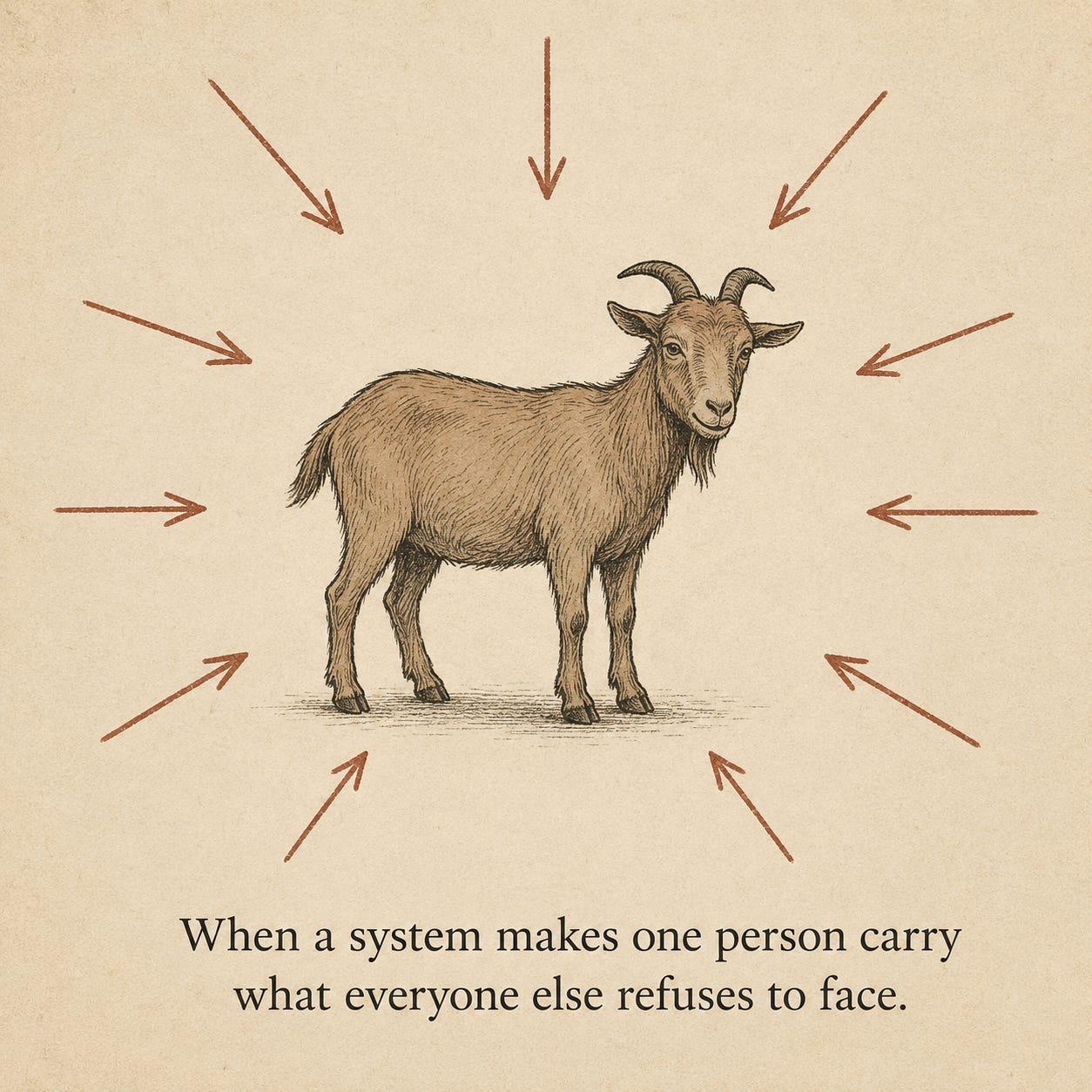
The difficult middle lies in distinguishing responsibility from agency. We are not responsible for every injury we must learn to live with, and becoming conscious of our response does not make us the cause of what happened. Yet what is not our fault may still become part of our psychological task. We may have to reckon with consequences we did not create, patterns we did not choose, and conditions we cannot repair alone. This is not an admission of blame. It is the recovery of agency.
The essential questions, then, are not only: What is mine? and what belongs to the other person or to the world? There is a third: What is mine to do in response to what is not mine? Psychological maturity may depend upon holding all three questions at once, without using the outer world to evade self-examination or using self-examination to excuse the outer world.
A person can be genuinely wronged and still become bound to the identity, relationships, and patterns that form around the wound. Recognizing this does not transfer responsibility from the person or conditions that caused the harm. It acknowledges that suffering can acquire a psychic life of its own.
At the same time, the toxic dance between victimhood and martyrdom can become a kind of spell. Suffering becomes an identity, and self-sacrifice becomes proof of goodness. Breaking that spell requires looking within, but looking within is not the same as accepting blame.
This is part of what Hillman was pointing toward. If the psyche is located entirely within the individual, then the world itself escapes psychological examination. We become increasingly sophisticated at diagnosing individual neuroses while rarely asking whether some of what we call pathology might also be a response to pathological conditions.
Perhaps the paradox of modern therapy culture is that everyone gets to be neurotic, but each of us is expected to heal individually.
Psychology itself emerged from philosophy, but in becoming an institutionalized modern discipline, it increasingly separated itself from its philosophical and metaphysical roots. I discuss this further in Decentering Modern Psychology. Once we widen the frame beyond the isolated psychological self, an older question returns: What is psychology ultimately trying to help the human being become?

Liberating the Soul
Sarah Huxtable Mohr, writing from the perspective of Islamic liberation psychology, approaches this question through the classical concept of telos, the end or purpose toward which something is directed. For Mohr, the telos of liberation psychology is justice. Her work also challenges psychological approaches that isolate mental health from the social conditions in which suffering occurs.
But the question of telos is much older than psychology. What is a human being? What are we here for? What constitutes a good life? What does it mean to flourish? These questions occupied philosophers long before psychology became an independent discipline, and they run through many of the Islamic thinkers explored in this essay.
Within the Islamic philosophical tradition, however, human flourishing could not ultimately be separated from God. Nor does the human person inhabit a purely psychological or material universe. We live within relationships, communities, histories, bodies, and environments, but also within a cosmos containing both the seen and the unseen.
Human agency is real, but it is not absolute. We act upon the world and one another, and are ourselves acted upon. Much of what shapes a human life lies beyond the sovereignty of the individual self.
We certainly speak the language of psychology more fluently than ever before. But naming emotions is not the same as feeling them. Therapy speak does not cultivate consciousness. Like any language, it can be used to justify, conceal, or even facilitate harm.
This essay explores how the Islamic philosophical tradition understood the human person, what it understood human life to be for, and how those understandings informed psychological, ethical, and spiritual flourishing.
Why Islamic Philosophy?
Because it is the tradition from which I write. My intellectual and spiritual formation has been shaped by both the Islamic sciences and Western psychology. This essay is one attempt to bring these conversations into dialogue.
Many of the philosophical, medical, and psychological ideas that later shaped the Western intellectual tradition were preserved, developed, and transmitted by Muslim scholars. Yet Islamic understandings of the human person are still rarely engaged on their own terms within contemporary psychology.
II. Wounds, Illusions, and Inner Freedom
Where Are the Elders?
The ancients did not know everything, nor do I wish to romanticize a past made alluring simply by its distance. Yet many understood the world as more than a collection of inert objects. They saw it as ordered, meaningful, and alive with significance rather than merely a site of extraction or endless progress.
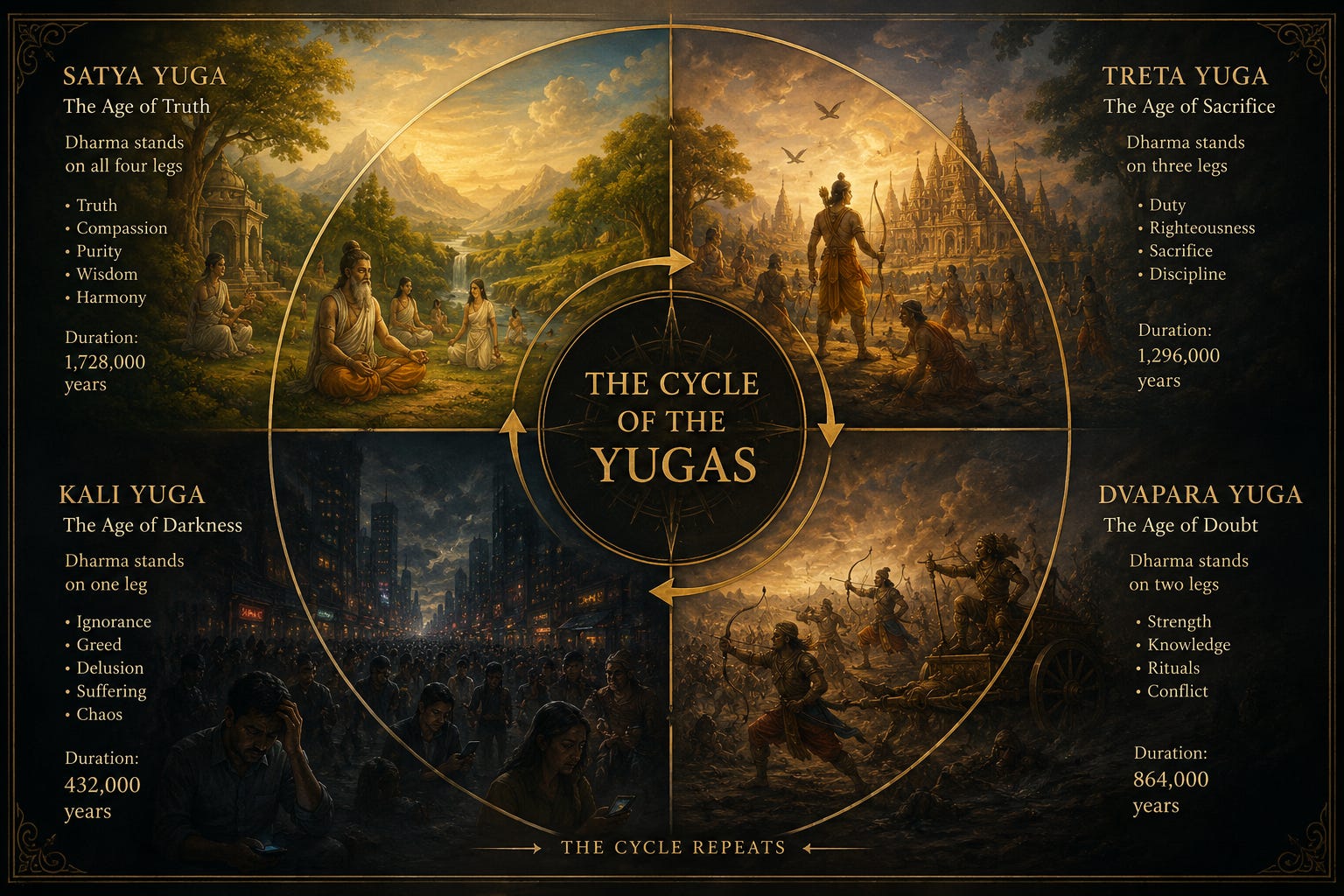
Across civilizations, many traditions described periods in which humanity would fall into profound forgetfulness, losing sight of what is sacred amid increasing preoccupation with the material world.
In Hindu cosmology, for example, history unfolds through cyclical ages (Yugas). Kali Yuga, the fourth and final age in the cycle, is traditionally understood as a period of spiritual decline, moral confusion, and growing estrangement from the sacred.
Not only that, but those who tried to remind society of what mattered most were not always celebrated. Prophets were persecuted, sages dismissed, mystics exiled, and saints condemned.
The Qur’an captures a strikingly familiar human response. When prophets warned their people of the consequences of injustice and spiritual heedlessness, they were met with dismissal: “You are pessimistic. You bring us bad fortune.” The reply came just as swiftly: “Your omen is with yourselves” (36:19).
Read psychologically, the exchange is profound. Rather than confronting what the messengers reveal, the people locate the source of their discomfort in the messengers themselves. The deepest misfortune is not the one announced by the messenger, but the condition that prevents a people from recognizing it. Every age struggles to perceive its own blind spots while living within them. Ours is no exception.
We have become remarkably adept at managing human experience, yet we continue to struggle to distinguish psychological suffering from spiritual crisis. At times, we confuse one for the other, to the detriment of both the individual and the culture.
The problem becomes particularly complicated when the institutions entrusted with preserving the sacred become sources of injury themselves.
Religious trauma remains both underdefined and widely misunderstood. It is often associated with those who have left religion altogether. But what of those who continue to believe in God while no longer trusting the institutions that claim to speak in God’s name?
In some cases, those institutions have also contributed to the dilution of the traditions they inherited, subordinating ethical and spiritual concerns to political, ideological, or geopolitical interests. The result is that many either turn away altogether or find themselves caught between competing extremes.
Organized religion can become just as disorienting as scientism when either claims exclusive authority over truth while leaving little room for mystery, humility, or complexity.
We fret over the branches while the deeper roots continue to rot.
At its heart, religious trauma is a rupture: a severing of our relationship with the sacred, with the self, with the world, and with the Source of it all.
We cannot keep patching over this wound.
What Has Been Forgotten?
The breath itself bears witness to a rhythm deeper than culture, ideology, or identity. It is not a trend but a deep structure of the human condition.
Inhale.
Exhale.
Inhale.
Exhale.
It will all pass.
How, then, might we make room for the ineffable, for humility, and for perspectives that challenge and transcend the more rigid tendencies of the human ego?
Life itself has a way of breaking our hearts.
One might even say that Allah sometimes allows the heart to break so that we may remember what we have forgotten. The ego is remarkably gifted at convincing us that we are self-sufficient.
That does not mean suffering is inherently good, nor that trauma should ever be romanticized. Trauma can become a site of profound illumination, but also one of profound darkness. It can soften the heart with love or harden it with illusion. Much depends on how we meet ourselves again and again.
Many traditions understand the heart not merely as a metaphor for emotion, but as a faculty of perception. We move between clarity and confusion, remembrance and forgetfulness, healing and repetition. Most of us live somewhere between these states. I explore this understanding of the heart further through the works of a Christian mystic and a Muslim mystic in The Metaphysics of Awakening the Heart.
I spent years moving in and out of the mental health system while slowly uncovering the impact of severe childhood abuse. I barely made it through. The worst part was the silence. Or perhaps I should say, it is the silence. Deafening. Oppressive.
If you choose to join me in these explorations, I invite you to remain open to different ways of understanding the human person. Perhaps some of those ancient trees have been neglected rather than lost.
Where are the elders? Perhaps they have been here all along, waiting for us to become still enough to listen.
The Paradox of Religious Trauma
Many have argued that religion is little more than a comfortable fear box. Marx famously called it “the opium of the people.” I understand the critique. Religious and spiritual bypassing can indeed become deeply regressive and dangerous. Yet psychology is not immune to the same temptation. Psychological insight, therapeutic language, and even self-awareness can become another way of evading the deeper work of transformation.
Earlier in my life, both religion and psychological insight became refuges from developmental tasks I was not yet ready to face. They gave me structure, certainty, and even a sense of moral superiority. But they also gave me places to hide. Whenever I bypass my humanity, spiritual growth becomes superficial and short-lived. I mistake escape for transformation while remaining fundamentally unchanged.
And then what?
Then comes tension, complexity, and mystery. Without the capacity to live with paradox, faith begins to crumble. Rather than learning to dwell with what I cannot immediately reconcile, I become increasingly sophisticated in the ways I resist it.
Paradox is not the enemy of faith. It is often where faith matures. The closer we draw to the Divine, the more deeply we encounter the mystery that always exceeds our understanding.
Many hearts are wounded in the name of religion. Yet those same hearts may sometimes discover healing through a deeper encounter with God.

Abuse, coercion, manipulation, humiliation, and spiritual exploitation committed in the name of religion remain injustices for which human beings are accountable. God does not sanctify them.
Yet it is often through these very wounds that we begin the painful work of distinguishing God from our projections of God. As those projections loosen, we may encounter not the deity fashioned in our own image, but Reality itself.
No Ego Death, Please!
It can be terrifying to surrender.
For the ego, yes.
For the soul, no.
When we sit honestly with our deepest fears—abandonment, rejection, insignificance, failure, even death—we often arrive at the same threshold: the fear of no longer being who we imagine ourselves to be.
What if the ego is not the problem, but simply terrified? What if it requires training rather than condemnation? What if spiritual maturity is not the destruction of the self, but its gradual reordering toward what is Real?
The Islamic contemplative tradition has long understood this. It does not begin by attempting to destroy the self; it begins by educating it. Mysticism is not simply the pursuit of extraordinary experiences or esoteric knowledge.
For the Muslim mystic, surrender to Reality is inseparable from the direct knowledge of God, unfolding through the disciplined transformation of the human person. The aim is not escape from the world, but freedom from illusion through the gradual refinement of the self.
The inner work unfolds through the refinement of the nafs, often translated as the ego-self. Shaped by fear, desire, attachment, and self-preservation, the nafs is nevertheless capable of profound change through discipline, remembrance, and love.
The rūḥ, by contrast, is the Spirit breathed into the human being by God, continually orienting us toward the Divine. The spiritual path is therefore not a rejection of the self, but the gradual harmonization of these dimensions.
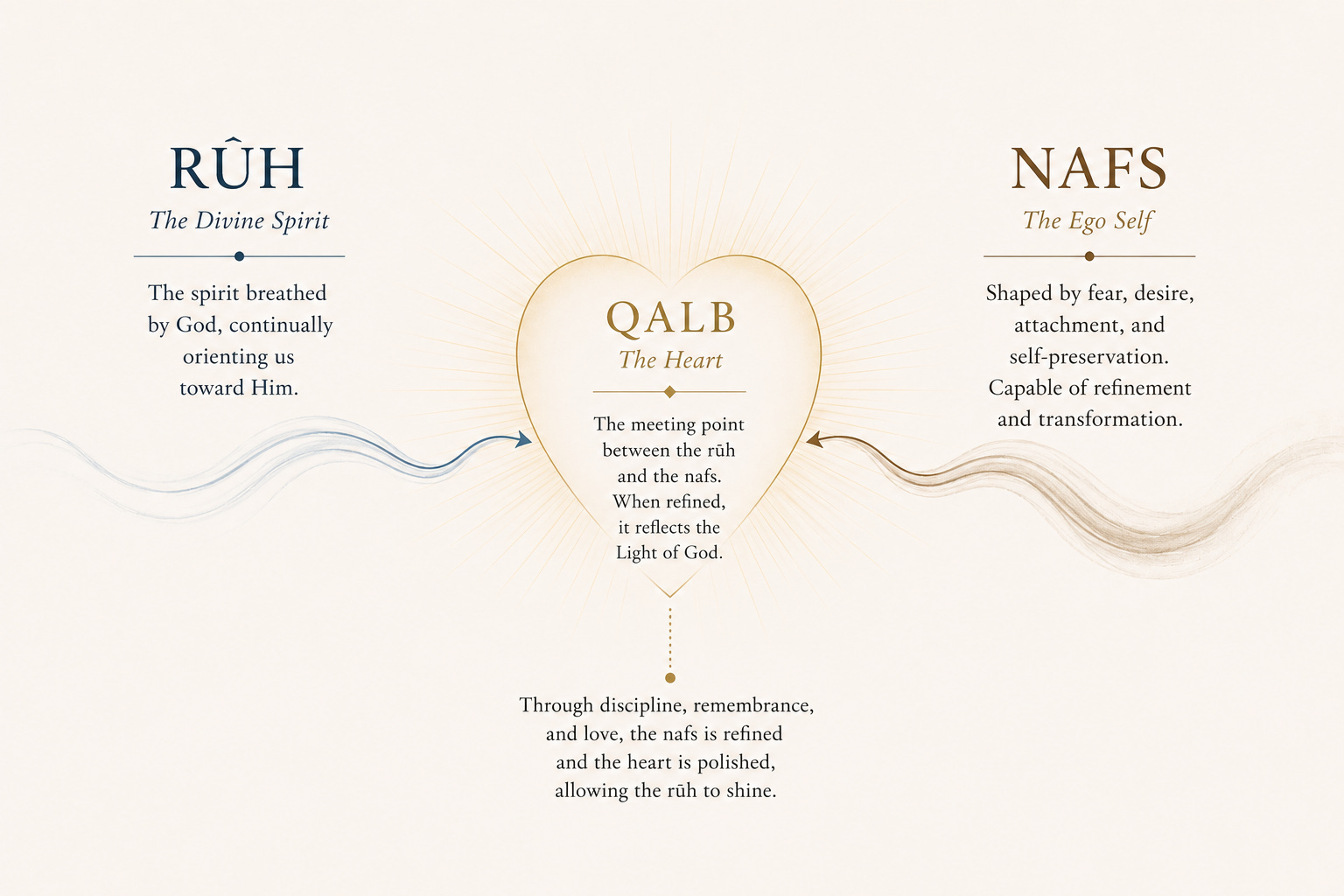
For this reason, the language of “ego death” is often misunderstood. The Sufi masters did not seek to destroy the ego indiscriminately. They disciplined it. They refined it. They strengthened the vessel long before the symbolic annihilation known as fanāʾ could unfold.
One does not leap into the fire unprepared.
The encounter with the Divine is not for the faint of heart. For many, what is needed is not further dismantling, but greater integration.
Safety. Grounding. Discernment.
A self psychologically capable of bearing what it may encounter.
Where contemplative traditions once formed seekers through years, often decades, of discipline, accountability, and discernment, some contemporary spiritual communities have come to equate intuition with wisdom and charisma with maturity—transmission and lineage matter, particularly for those who undertake a serious contemplative path.
Ultimately, if someone has made their way through the distortions, forgetfulness, distractions, and wounds of ordinary human existence, yet still finds themselves searching for what is true, that impulse itself deserves reverence.
The task of the guide is not to mistake every defence in the seeker for an obstacle to God.
Sometimes what appears to be an obstacle is the very vessel that must first be strengthened before it can receive. This is why authentic guidance matters. For the sincere seeker, much unfolds gently and in due time.
Do not be careless with your soul.
The Universal Wound
Whether someone is Muslim, Christian, Jewish, atheist, agnostic, or none of the above, unbearable suffering confronts us with something profoundly human. Gender, sexuality, belief, and skin colour may shape how suffering is experienced, understood, and treated, but they do not make anyone’s pain less deserving of recognition and care.
We give our suffering different names. We classify it, diagnose it, theologize it, and reinterpret it. Yet the wound remains remarkably familiar. We instinctively resist pain, even though that resistance often deepens what we are trying to escape.
Religious trauma is one expression of this universal wound. It can emerge when religious teachings, authority, institutions, or practices become entangled with coercion, shame, abuse, or fear. Whatever we hold most sacred can also become entangled with our deepest wounds.
Before exploring where our beliefs diverge, it is worth recognizing where we already meet. We may arrive at different theological or philosophical conclusions while still sharing the realities of being human. Common ground does not require us to collapse our differences, treat distinct traditions as interchangeable, or claim that all religions are ultimately saying the same thing.
Human experiences may point in similar directions without being understood or expressed in the same way. Difference is not a failure, nor must it become enmity. There is nothing righteous about turning disagreement into dehumanization, violence, or senseless killing.
The Qur’an expresses this beautifully: “Come to a word that is common between us and you” (Qur’an 3:64). Without removing the verse from its particular theological context, we can also recognize in it an ethic of encounter: begin with what can be shared while remaining honest about where we differ.

Like young people in other religious traditions, many young Muslims grow up relating to God not as the Source of mercy, but as they might relate to a frightening or emotionally unpredictable caregiver: vigilant, fearful, and uncertain when love might be withdrawn.
It is a profound psychological injury when parents or teachers weaponize God as a means of control under the guise of knowing what is best for those entrusted to their care. This pattern is by no means unique to any one religious community. Such dynamics emerge whenever fear eclipses mercy.
It is also worth asking what lies beneath this form of control. It does not necessarily arise from malice. Sometimes parents genuinely fear for their children and believe that control is an expression of care. At other times, concern for a child’s relationship with God becomes entangled with fear of people: What will others say? What will the community think? What does my child’s behaviour say about me?
When our own relationship with God is organized primarily around fear and external judgment, we risk passing that same orientation on to our children.
There is another face of religious life that deserves equal attention: love. Love is expansive. This does not mean that love is without boundaries, reverence, or accountability. But if what we call love of God repeatedly manifests as contraction, control, and preoccupation with the gaze of others, it is worth examining what is actually moving us.
Not everything we call fear of God is taqwā (التقوى). Some of it may actually be our own fear projected onto our image of God: fear inherited from our parents, fear of punishment, fear of rejection, fear of the community, fear of getting it wrong.
So what, then, is taqwā?
The word itself offers us a clue. Taqwā shares its Arabic root with wiqāya (وقاية): protection, or safeguarding something from harm.
Perhaps, psychologically, we might understand taqwā not simply as being “afraid” of God, but as learning to guard what is sacred: our relationship with God, and the heart through which that relationship is lived.
The Prophet ﷺ made a striking gesture when speaking about taqwā. Pointing to his chest, he repeated three times: “Taqwā is here.”
To locate taqwā in the heart is not to make it private or invisible. In the wider context of the hadith, the condition of the heart is revealed in how we regard and treat other human beings.
What if taqwā, then, asks us not only what we fear, but what we are protecting? What are we cultivating in the heart? And what kind of relationship with God are we passing on to those entrusted to our care?
Fear of people also introduces an element of performance into religious life. When the gaze of family or community becomes the measure of faithfulness, it can become internalized. A person may continue performing even when no one is watching, or learn to live a double life: one self for the world and another behind closed doors. All the way into old age!
This can create a painful paradox. When someone has not learned how to relate to God inwardly, through the heart, beneath all the performance, the very relationship parents were trying so desperately to protect may eventually become fractured. What was intended to preserve faith can end up alienating a person from it.
Perhaps this is why some of the most important religious work parents can do for their children is their own inner work. One of the most profound reminders I encountered as a parent comes from Jungian analyst Robert A. Johnson in his book, Owning Your Own Shadow:
“If you wish to give your children the best possible gift, the best possible entree into life, remove your shadow from them. To give them a clean heritage, psychologically speaking, is the greatest legacy. And, incidentally, you will go far in your own development by taking your shadow back into your private psychological structure, where it first originated and where it is required for your own wholeness.”
I first encountered this passage almost ten years ago, and it awakened something in me. It helped propel me deeper into my inner life, particularly as I struggled to distinguish the nature of God from perceptions shaped by my unprocessed trauma. I also began noticing how differently those around me understood and represented God through their own experiences. (More on the shadow and Johnson here: Shadow Work: How Our Unlived Life Looms.)
Other people’s journeys may take very different forms. Mine required, and still requires, learning to separate truth from opinion, God from the projections placed upon God, and the tradition from what human beings have sometimes done in its name.
The Qur’an tells us that God has prescribed mercy upon God’s own Self (Qur’an 6:54), while the Prophet ﷺ relates the Divine words in a hadith qudsī: “Indeed, My mercy prevails over My wrath.”
Together, these texts provide a theological reference point for distinguishing the Divine from images shaped by coercion, abuse, manipulation, or unprocessed human fear. In Islamic, Christian, and Jewish contexts alike, religious trauma raises an important question: is a person rejecting the Divine, or reacting to the image they were taught to fear? These are not necessarily the same.
In moments of profound depression or suicidal despair, however, this distinction is not the immediate concern. For some people, the wish to die may be bound up with a desperate wish for unbearable pain to end. The first task is not to settle theology, but to help make the pain survivable. Questions of God, faith, and transcendence can be explored later, as healing creates space for them.
Not everyone begins from the same place. For some, the Divine is central to their experience of suffering. For others, that dimension has become inaccessible or is itself a source of distress. For still others, it is simply not part of their worldview.
Effective spiritual care and mental health support must meet people where they are. Neither a spiritual nor a secular framework should be prematurely imposed. The therapeutic space must allow questions of meaning, faith, doubt, and transcendence to emerge safely, if and when they become relevant.
Such complexity calls for psychotherapeutic approaches capable of engaging the relationship between mind, body, and soul without reducing one to the other.
Because pain that remains unspoken does not disappear.
Neither does the soul.
Asceticism Is Not Despair
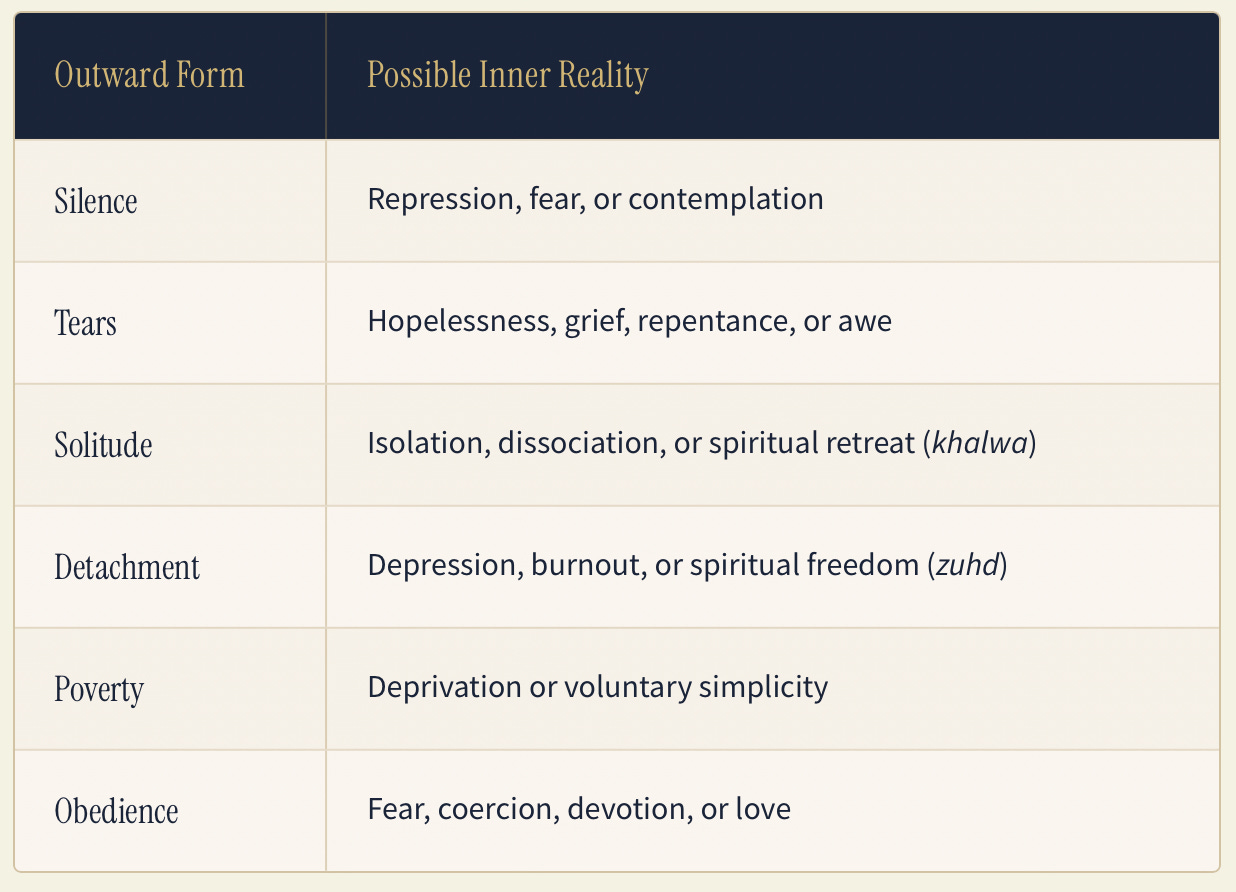
Ascetic practices appear across many of the world’s religious and contemplative traditions. Although their meanings, aims, and forms differ considerably, they present an important challenge for psychology: detachment can look very different from the outside than it feels from within. What appears to be withdrawal, diminished interest, or disengagement may arise from profoundly different inner states.
Asceticism enters this discussion because religious and contemplative traditions have long understood detachment as a way of living with suffering and the instability of the world without being consumed by either. Some of the scholars discussed in this essay, who later came to be recognized as saints, did not merely theorize this way of being.
Many of them lived it, a subject I explore in Between Saints and Spirits. Nor is asceticism limited to the renunciation of material wealth. It can also involve our attachments to recognition, certainty, information, identity, and relationships. This does not necessarily mean abandoning these things, but loosening their hold upon us.
Within the Islamic tradition, this question is particularly visible in the concept of zuhd. The Sufi masters were often deeply detached from the world, but detachment did not mean indifference. Zuhd was not simply withdrawal from life. One could participate fully in the world, cultivate knowledge, serve others, appreciate beauty, fulfil one’s responsibilities, and remain inwardly free from what is transient. A person may loosen their attachment to the world while becoming more present to it, not less.
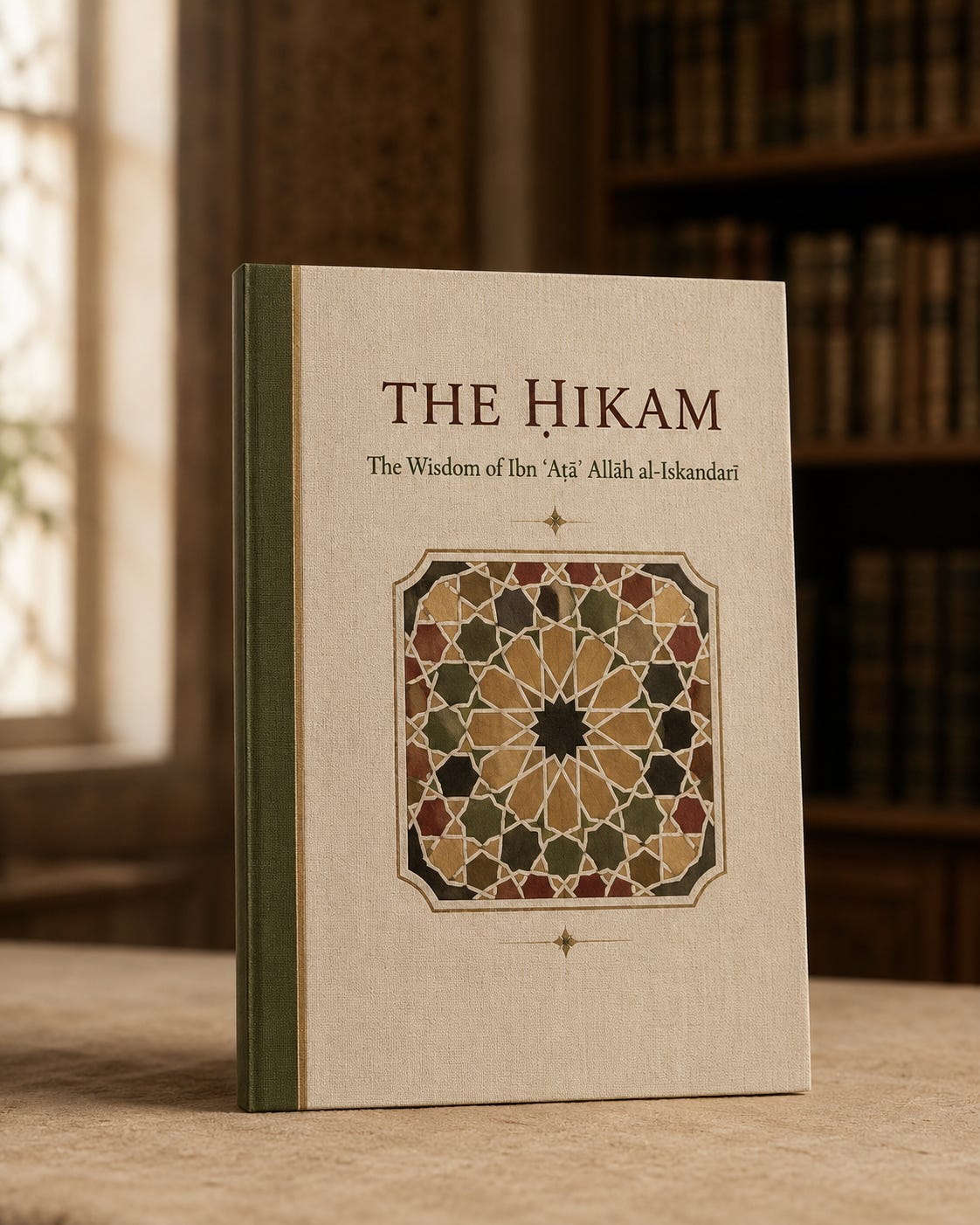
Ibn ʿAṭāʾ Allāh al-Iskandarī expresses this beautifully in the second of his Ḥikam:
إرادتُكَ التَّجريدَ مع إقامةِ اللهِ إيّاكَ في الأسبابِ من الشهوةِ الخفيّة، وإرادتُكَ الأسبابَ مع إقامةِ اللهِ إيّاكَ في التجريدِ انحطاطٌ عن الهمّةِ العليّة
Your desire for detachment while God has established you among worldly means is a hidden desire, and your desire for worldly means while God has established you in detachment is a descent from lofty aspiration.
Ibn ʿAṭāʾ Allāh al-Iskandarī, al-Ḥikam al-ʿAṭāʾiyya, Ḥikma Two
The wisdom moves in both directions. Detachment does not require us to abandon our responsibilities, capacities, or participation in the world when that is where God has placed us. Nor should humility become an excuse for diminishing what has been entrusted to us.
When a person has been granted a capacity for greater detachment, clinging to conventional measures of security, achievement, or worth can itself become a diminishment of aspiration. The task is not to play larger or smaller than we are, but to discern our place with enough honesty to inhabit it fully.
Do not misunderstand me. There are many reasons to despair when we look honestly at the state of the world. War, injustice, cruelty, loss, and suffering are real, and no spiritual teaching should require us to pretend otherwise. The distinction I am making here is not between those who despair and those who are spiritually evolved.
Rather, ascetic detachment and suicidal despair may appear similar from the outside while arising from profoundly different inner orientations. This kind of dialogue is hardly unprecedented. Buddhist contemplative traditions, for example, have been brought into sustained conversation with psychotherapy for decades. Islamic contemplative traditions may likewise offer conceptual resources for understanding states that outwardly resemble one another while differing considerably in meaning.
Asceticism (zuhd) is not a hatred of the world, nor a denial of beauty, joy, or love. Rather, it is the cultivation of inner freedom, the refusal to allow transient things to become ultimate.
Suicidal despair, by contrast, arises not from freedom in relation to the world, but from profound constriction. Suffering narrows the horizon of possibility until life itself becomes difficult to imagine as bearable. Although both states may involve a turning away from worldly concerns, they move in opposite directions.
When that constriction becomes overwhelming, particularly when someone is experiencing suicidal thoughts or feels unable to remain safe, spiritual interpretation should never replace appropriate psychological, medical, or crisis support. Seeking help is not a failure of faith, nor does it diminish the spiritual meaning a person may later find in what they have endured.
Asceticism loosens attachment to what is transient while deepening one’s capacity to engage life with presence and responsibility. Despair constricts the soul until hope, mercy, and meaning become increasingly difficult to perceive.
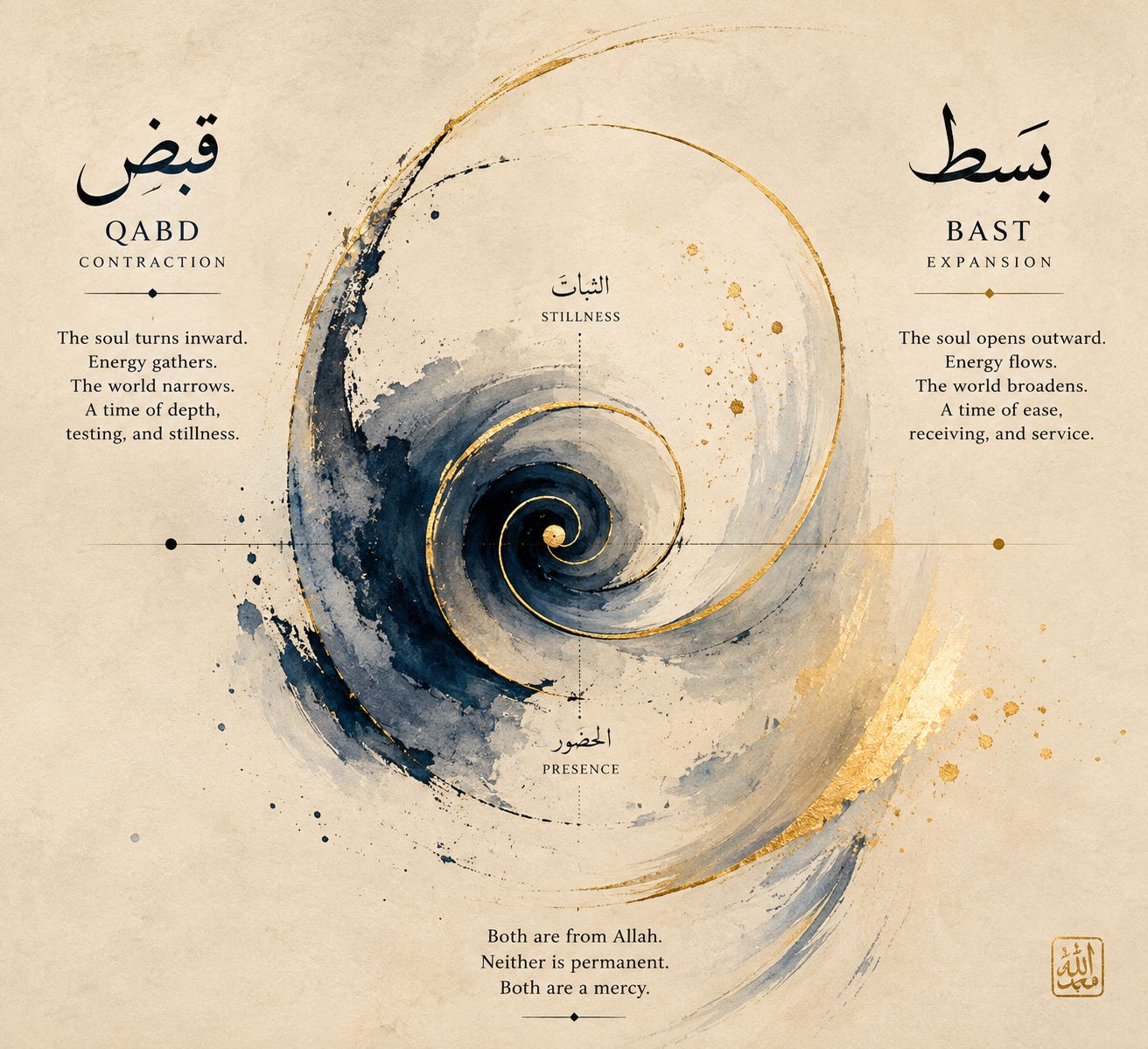
In contraction, we need compassion. In expansion, we need it too. Neither state is inherently lesser or greater. Both can become sacred when lived in awareness of the Divine Presence.
III. Recovering a Psychology of the Soul
Al-Balkhī and the Myth of Newness
During my postgraduate studies in Islamic psychology, I encountered the work of the ninth-century Muslim polymath Abū Zayd al-Balkhī (850–934 CE), whom I quoted at the beginning of this essay. Al-Balkhī articulated a remarkably sophisticated understanding of the reciprocal relationship between thoughts, emotions, behaviour, and the body. Readers familiar with cognitive behavioural therapy may recognize striking parallels.
In his work, Masāliḥ al Abdān wa al Anfus (Sustenance for Bodies and Souls), al-Balkhī distinguishes between illnesses of the body and illnesses of the soul while emphasizing their continual influence upon one another. He describes how patterns of thought can intensify emotional suffering and offers practical methods for cultivating healthier cognitive and emotional responses.
One example is his use of al-ʿilāj bi-l-ḍidd, treatment through the opposite. Rather than allowing a distressing emotional state to dictate one’s behaviour, the person deliberately cultivates a response that counters and gradually weakens it. The resemblance to behavioural principles, including what might today be described as acting contrary to an emotional impulse, is difficult to miss.
Yet these parallels should not tempt us to translate al-Balkhī into modern clinical language. His work reminds us that many insights we celebrate as distinctly modern have precedents within much older intellectual traditions that are too often overlooked. More importantly, similar techniques can emerge from profoundly different understandings of what it means to be human.
For the ninth-century physician Abū Zayd al-Balkhī, care of the body and care of the soul belonged to an interconnected understanding of human wellbeing. Psychological suffering could affect the body, just as bodily illness could affect the soul.
The technique may look familiar. The vision of the human person surrounding it is not necessarily the same.
The Movement of Ideas
Nostalgia alone is another form of bypass. Yet remembering the past can become a source of wisdom when it invites integration rather than idealization.
European intellectual life was deeply shaped by works transmitted through and further developed within the medieval Islamic world, just as Muslim scholars had themselves engaged earlier philosophical and scientific traditions, including those of the Greeks.
Institutions associated with the great translation movements, most famously Bayt al-Hikmah (the House of Wisdom) in Baghdad, fostered an intellectual culture in which works of philosophy, medicine, mathematics, astronomy, logic, and the natural sciences were not merely translated into Arabic, but studied, debated, critiqued, and expanded.
Muslim scholars did not inherit Greek philosophy uncritically. They engaged it with intellectual seriousness, preserving what they found compelling, developing what they could carry further, and challenging what they believed to be mistaken. Knowledge was not understood as the possession of a single civilization, but as something to be sought wherever it could be found and evaluated in light of reason, experience, and revelation.
The aim, then, is neither to romanticize the Islamic past nor to dismiss contemporary psychology. Rather, it is to recover a model of intellectual engagement in which traditions remain open to dialogue without surrendering their own philosophical foundations.
The familiar categories of East and West begin to lose their sharpness when we follow the movement of ideas rather than the movement of empires. Much of the intellectual tradition that flourished in al-Andalus, in what is now Spain and Portugal, is geographically Western while belonging to the medieval Islamic world.
What we now call modern Western thought emerged from a far larger civilizational conversation than is often acknowledged.
Knowledge rarely belongs to a single civilization. It is translated, debated, transformed, and handed on. Wisdom has never cared much for the borders we have drawn around ourselves.
Modern accounts of intellectual history have not always acknowledged the full complexity of these exchanges. As psychology emerged as a distinct discipline, particularly in the nineteenth and twentieth centuries, it increasingly developed within secular frameworks that placed older philosophical, metaphysical, and theological understandings of the human person outside its boundaries.
Contemporary Islamic psychology began to re-emerge during the latter half of the twentieth century amid broader efforts to reconsider the relationship between modern psychological knowledge and Islamic understandings of human life. Rather than simply rejecting modern psychology, Muslim scholars and practitioners have sought to recover and further develop a more integrated account of the human being, one that honours psychological, ethical, philosophical, and spiritual dimensions.
Ibn Sīnā and the Integrated Human Person
Few figures better exemplify the integrated intellectual vision of the medieval Islamic world than Ibn Sīnā (Avicenna, 980–1037 CE). A physician, philosopher, theologian, and polymath, he continues to shape intellectual history through his contributions to medicine, philosophy, and what we would now recognize as aspects of psychology.
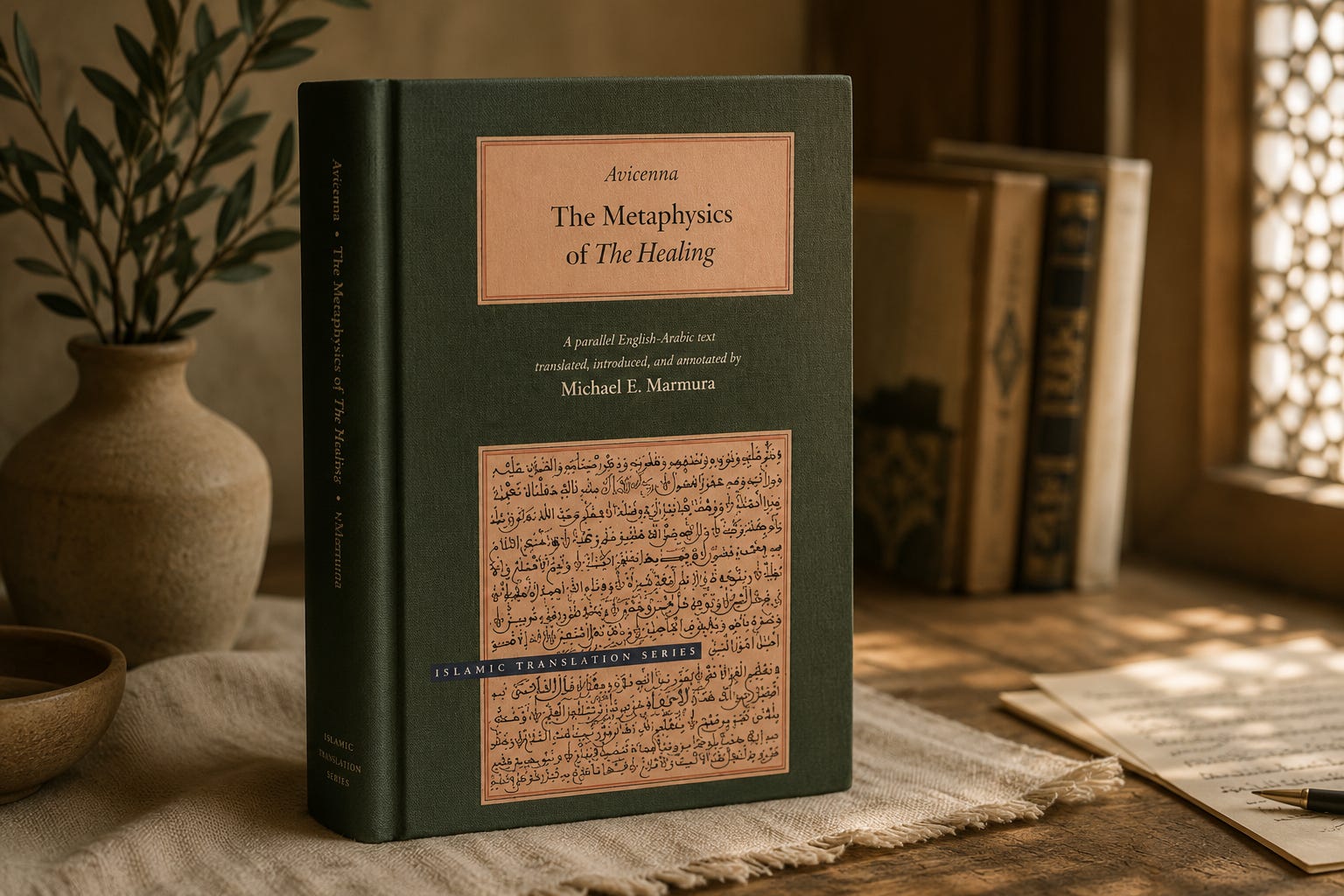
Among his most enduring contributions is the famous Flying Man thought experiment. Ibn Sīnā asks us to imagine a person created fully formed, suspended in space, deprived of all sensory contact with the external world. Such a person would perceive neither body nor environment, yet remain aware of their own existence. For Ibn Sīnā, this illustrated that self-awareness could not be reduced to bodily sensation alone, offering one of the earliest and most influential reflections on consciousness in the history of philosophy.
He distinguished between the potential intellect (al ʿaql al hayūlānī | العقل الهيولاني) and the Active Intellect (al ʿaql al faʿʿāl | العقل الفعّال). The human intellect begins in a state of potentiality and becomes actualized through experience, perception, reasoning, and the apprehension of intelligible truths. The Active Intellect plays an important role in this process, but knowledge does not simply descend upon a passive mind. The intellect must itself be prepared.
Ibn Sīnā also distinguished between discursive thinking, in which understanding develops through successive acts of reasoning, and higher forms of intellection in which something may be apprehended more immediately. Yet this more immediate knowing was not an abandonment of reason. It emerged from the cultivation of the intellect itself.
What might this mean for an ordinary person today? We can possess enormous amounts of information while remaining largely unchanged by what we know. I may understand intellectually that a particular pattern is harming me, for example, yet continue repeating it. The knowledge is present, but something has not yet been fully realized.
In more contemporary language, we might distinguish between knowing something conceptually and knowing it in a way that reorganizes how we perceive, choose, and live. This is not Ibn Sīnā’s own psychological formulation, but his account of the movement from potentiality toward actualization offers another way of thinking about human development. Knowing is not merely the accumulation of information. Human capacities themselves can be cultivated and brought more fully into actuality.
While Ibn Sīnā affirmed the immaterial nature of the soul, he also recognized the reciprocal relationship between body and psyche. His account of the soul and its faculties—developed long before psychology existed as a modern discipline—remained deeply rooted in the philosophical and rational tradition.
The movement described here is primarily intellectual: from potentiality toward actualization, from what can be known toward the capacity to know it. As we move through later thinkers, however, the picture begins to change. Reason does not disappear, but other faculties of knowing increasingly come into view.
Al-Ghazālī and the Crisis of Certainty
Iḥyāʾ ʿUlūm al Dīn (The Revival of the Religious Sciences | إحياء علوم الدين) remains one of the most influential works in Islamic spirituality and theology. Yet its enduring significance lies not only in its scholarship, but also in the profound existential crisis from which it emerged.
At the height of his career as one of the most celebrated scholars of the Muslim world, Abū Ḥāmid al Ghazālī (1058–1111 CE) suddenly found himself unable to lecture despite no identifiable physical illness. Al Ghazālī described the affliction as having descended upon his heart and then affected his physical condition. Beneath it was a crisis of faith, purpose, and sincerity. He began questioning not simply what he knew, but why he sought and taught knowledge at all.
Leaving behind his prestigious position, he entered a prolonged period of withdrawal, contemplation, travel, and spiritual discipline. From this period emerged the Iḥyāʾ, a work that sought to reunite what had become fragmented: Islamic law (sharīʿah), theology, ethics, and spirituality. In doing so, al-Ghazālī played a pivotal role in integrating the Sufi path into mainstream Sunni intellectual and religious life. The inward sciences were not presented as the concern of mystics alone, but as an essential dimension of the religious life itself.
He later reflected on this journey in his spiritual autobiography, Al Munqidh min al Ḍalāl (Deliverance from Error), often regarded as an unusually early first-person account of intellectual, existential, and spiritual crisis. After examining theology, philosophy, and other paths to certainty, he concluded that the way of the Sufis could not be grasped through study alone. What distinguished it was not merely what one knew, but what could only be realized through practice and experience.
For al-Ghazālī, intellectual brilliance was never enough. Genuine transformation required sincerity, humility, disciplined practice, and a willingness to let truth reshape one’s life. In the Sufi tradition, this path of inner refinement is known as sulūk, the gradual journey of the wayfarer toward God.
Suhrawardī and the Illumination of the Soul
Reality is woven from gradations of Light. Every level of existence reflects a different degree of its radiance, while the material world represents its greatest concealment. The spiritual path is not an escape from the world, but a return to the Source from which every ray originates.
Shihāb al Dīn Yaḥyā al Suhrawardī (1154–1191 CE), known as Shaykh al Ishrāq (the Master of Illumination), transformed the philosophical legacy of Ibn Sīnā through what became known as the Illuminationist (Ishrāqī) tradition. Drawing upon multiple philosophical and wisdom traditions, he described existence through a metaphysics of Light, with God as the Light of Lights (Nūr al Anwār).
The Qur’an proclaims:
“Allah is the Light of the heavens and the earth. The likeness of His Light is as a niche (mishkāt) within which is a lamp...” (Qur’an 24:35)
Across Islamic contemplative traditions, this imagery acquired profound metaphysical significance. The mishkāt came to symbolize receptivity to Divine illumination. At the same time, later Sufi metaphysics developed extensive understandings of Divine Light and the Muhammadan Light (Nūr Muḥammadī) as the primordial disclosure of Divine guidance within creation.
For Suhrawardī, the journey toward knowledge was therefore not simply a matter of acquiring more concepts. It required illumination. Knowing became inseparable from the condition and capacity of the knower.
The highest form of knowledge was not merely conceptual reasoning but knowledge by presence (al ʿilm al ḥuḍūrī | العلم الحضوري): an immediate mode of knowing in which something is apprehended through its presence to the knowing subject rather than through a mental representation.
Within this contemplative understanding, knowledge (ʿilm) is not information alone. It is inseparable from the cultivation of perception and the transformation of the knower. To know truth requires becoming increasingly capable of receiving it.
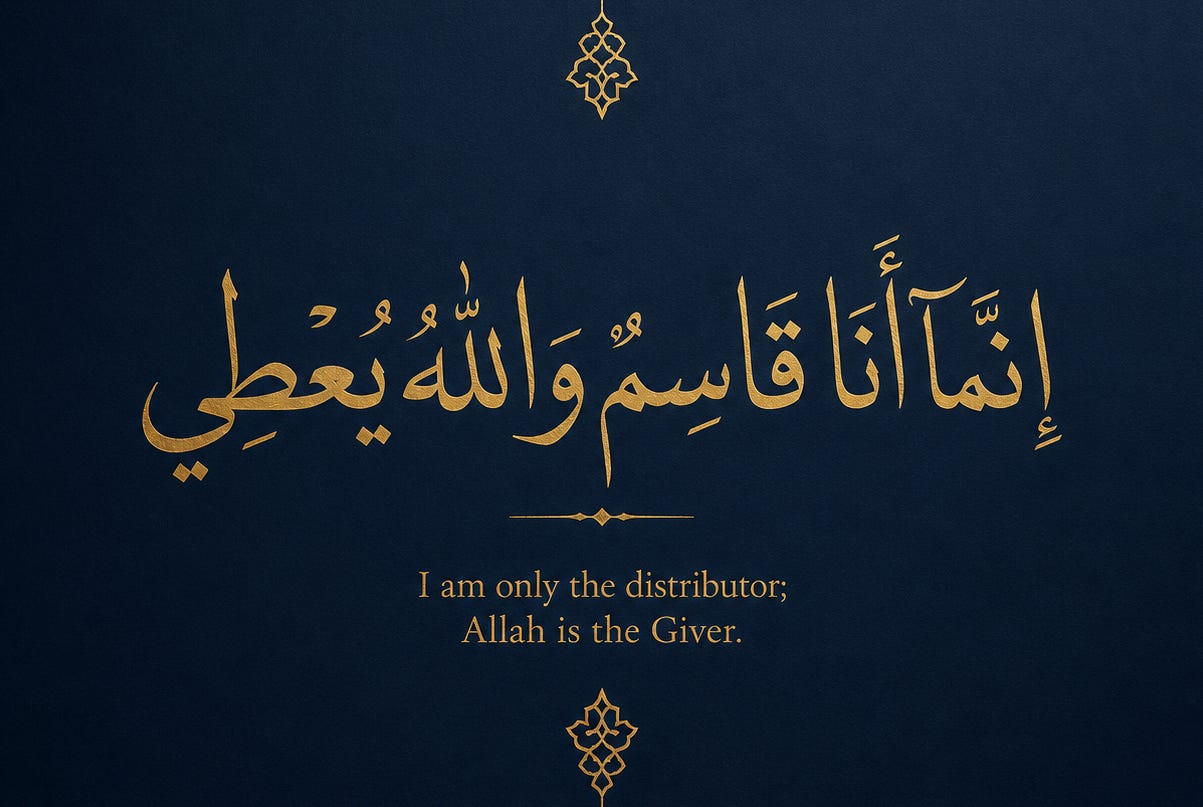
Within the Islamic intellectual tradition, this encompasses both the outward, exoteric (ẓāhir) and the inward, esoteric (bāṭin) dimensions of knowledge.
For contemporary psychotherapy, this raises an important question.
Can psychological healing be reduced to technique? Research consistently demonstrates that therapeutic outcomes are influenced, among other factors, by the quality of the therapeutic relationship. Long before psychotherapy emerged as a formal discipline, many philosophical, spiritual, and contemplative traditions cultivated teacher–student relationships, recognizing that genuine transformation unfolds through relationship as much as through instruction. Presence itself becomes part of the medicine.
Yet these traditions also recognized the dangers inherent in such relationships. Human beings naturally idealize, project, imitate, and seek certainty in those they admire. For this reason, adab (skillful conduct) was required not only of the student but also of the teacher. Authority was never intended to replace discernment. The integrity of the guide was itself understood to be part of the path.
Transmission is neither blind obedience nor mere intellectual instruction. Ideas may be communicated through words, but wisdom is also conveyed through presence, character, and example. In this sense, the guide teaches not only by what they know, but by who they are.
Information alone rarely transforms us. Receptivity must also be cultivated, and becoming capable of receiving subtle realities takes time. It requires attention, humility, sustained practice, and the willingness to allow knowledge to reshape the one who receives it. In Suhrawardī’s language, illumination is not simply something we think about. It is something we gradually become capable of seeing.
Suhrawardī’s philosophy of Light did not shield him from darkness in this world. Accused of heresy and executed in Aleppo, he became known as al-Shaykh al-Maqtūl (" the Slain Master””)**, a poignant reminder that one’s own age does not always welcome those who bear Light.
Ibn ʿArabī and Seeing Reality
The visible world is never merely what it appears to be. Every outward form points toward a deeper reality, and every level of existence discloses another degree of the Real.
Widely regarded as one of the most influential figures in the history of Islamic mysticism and philosophy, Ibn ʿArabī (1165–1240 CE) articulated one of the most comprehensive metaphysical visions in Islamic thought. Later scholars associated this with the expression Waḥdat al Wujūd (Unity of Being), although Ibn ʿArabī himself never used the term. At its heart is the understanding that all existence derives from, depends upon, and manifests the Divine Reality.
The spiritual journey, then, is not one of becoming divine, but of awakening to the Reality that has always sustained our existence. As perception is transformed, so too is our understanding of ourselves, others, and the world around us.
Like Suhrawardī, Ibn ʿArabī regarded dhawq (“taste”) as a genuine mode of knowing. Certain truths cannot be reached through intellectual analysis alone, but must be tasted through lived realization. Closely related to this is his rich understanding of khayāl (the imaginal faculty), not as fantasy or illusion, but as a mode of perception through which spiritual realities become manifest in symbolic form.
Later commentators distinguished between the connected imagination (al khayāl al muttaṣil), arising within the human soul, and the separate imagination (al khayāl al munfaṣil), an objective imaginal realm mediating between the sensory and the purely intelligible. The French philosopher Henry Corbin famously described this as the mundus imaginalis, the imaginal world, emphasizing that it is neither merely subjective nor simply physical. Rather, it is a distinct mode of Reality apprehended through a purified imagination.
His magnum opus, al Futūḥāt al Makkiyyah (The Meccan Openings), records a lifetime of insight shaped by worship, contemplation, study, travel, and unveiling. Mecca became particularly important to the work’s composition and spiritual landscape. Yet these experiences are never presented as ends in themselves. They are moments of unveiling that deepen one’s knowledge of God, oneself, and creation.
The Futūḥāt was the fruit of decades of disciplined study, spiritual companionship (ṣuḥbah), worship, ethical refinement, and rigorous inner work. Ibn ʿArabī was not writing for casual readers or spiritual consumers, but for those already immersed in traditions of scholarship, devotion, and spiritual discipline.
Today, many writings of the Sufi masters are available with a few keystrokes. This is both a gift and a challenge. Removed from the disciplines and forms of life from which they emerged, they are easily reduced to inspirational quotations, social media posts, AI-generated clips, or abstract metaphysical slogans. In the process, what was intended to transform the soul becomes fodder for algorithmically moulded content.
For Ibn ʿArabī, true knowledge does not merely expand the mind; it refines perception. We do not simply learn new truths. We gradually become capable of seeing Reality as it has always been.

From the perspective of contemporary psychiatry, some of the visionary and revelatory experiences described by Ibn ʿArabī may resemble phenomena that, in certain clinical contexts, could be interpreted as symptoms of psychosis or other altered states of consciousness. Yet resemblance does not imply equivalence.
Within much of the Sufi tradition, extraordinary experiences are neither dismissed as pathology nor accepted uncritically as signs of sanctity. Rather, they are discerned in light of a person’s character, ethical conduct, humility, and the ongoing formation of the soul.
Transpersonal psychology approaches these questions from a different, though often complementary, perspective. Rather than determining the metaphysical status of an experience, it asks how that experience functions within a person’s psychological life. Does it foster greater integration, compassion, humility, and meaning, or contribute to fragmentation, inflation, isolation, and impairment?
Jung’s understanding of symbolic imagery bears intriguing resonances with what Henry Corbin later described as the imaginal (mundus imaginalis) in his studies of Ibn ʿArabī. Yet the two frameworks are not identical. Both acknowledge dimensions of experience that exceed the individual ego. Jung explored these through concepts such as the collective unconscious and archetypes, while generally remaining within a psychological framework. Ibn ʿArabī, by contrast, understood imaginal perception as disclosing realities that participate in the Divine order of being and are therefore not reducible to subjective experience.
One might say that Jung is primarily concerned with whether an experience contributes to psychological integration, whereas Ibn ʿArabī is ultimately concerned with whether it draws the soul nearer to God.
Jung generally refrained from making definitive metaphysical claims about the ontological status of symbolic experience. Ibn ʿArabī, by contrast, situated such experiences within an explicitly theological and metaphysical vision of reality.
This distinction illustrates one of the enduring challenges within mental health care: distinguishing psychological illness from spiritual experience while recognizing that the two may, at times, interact.
IV. Toward a Transpersonal Psychology
What Might a Transpersonal Approach Include?
Transpersonal therapy is less a single modality than an orientation toward the human person, a distinction I also discuss in Decentering Modern Psychology. It recognizes that psychological healing extends beyond symptom reduction or behavioural change to include questions of meaning, identity, spirituality, purpose, and human flourishing.
The figures that follow illustrate different ways this orientation has found expression in contemporary clinical practice. Their approaches differ considerably in theory and method, yet each resists reducing the human person to symptoms alone.
However, a curious absence marks this history. Transpersonal psychology has engaged extensively with Jungian thought, Buddhist and Hindu contemplative traditions, psychedelic research, altered states of consciousness, and other approaches that challenged the boundaries of conventional psychology. Islamic thinkers such as Ibn Sīnā were sometimes acknowledged in passing, yet the conversation rarely continued much further.
This is striking because, as we have just seen, much more followed. Questions of consciousness, the soul, embodiment, imagination, spiritual development, direct experience, and different modes of knowing were developed across centuries of Islamic philosophical and contemplative thought. The thread was there. We did not keep following it.
Peter Levine | Somatic Experiencing works with the body’s innate capacity to process the effects of overwhelming experience. Rather than repeatedly reliving traumatic events, the emphasis is on restoring regulation through careful attention to bodily sensation, safety, and pacing.
David Treleaven | Trauma-Sensitive Mindfulness reminds us that mindfulness is not one-size-fits-all. For people with unresolved trauma, certain contemplative practices may become destabilizing. Thoughtful adaptation allows awareness to develop without overwhelming the nervous system.
John Bradshaw | Inner Child Work helped popularize ways of reconnecting with neglected or wounded aspects of the self. In practice, some clients arrive at this work quickly, while others require substantial safety before younger parts of themselves are ready to emerge.
Carl Jung | Dream Analysis regarded dreams as one of the psyche’s most profound modes of communication and an important avenue on the path of individuation. Dreams reveal symbolic patterns, unconscious conflicts, developmental tasks, and unrealized potentials. For Jung, attending to dreams was not merely a technique, but a way of participating in the psyche’s movement toward greater wholeness.
Bessel van der Kolk | Embodiment and Trauma: Although not a transpersonal psychologist, van der Kolk’s work underscores the importance of embodiment in trauma recovery. As he emphasizes in The Body Keeps the Score, body-based practices can help restore a sense of safety and support a more compassionate relationship with difficult emotions.
Francine Shapiro | Eye Movement Desensitization and Reprocessing (EMDR): Shapiro developed EMDR to help process traumatic memories that remain psychologically and physiologically unresolved. From a transpersonal perspective, EMDR may also create the spaciousness in which deeper questions of identity, meaning, and spiritual growth can emerge.
Natalie Rogers | Expressive Arts Therapy demonstrated that creativity itself can become a therapeutic language. Poetry, journaling, movement, painting, and other forms of expression can reveal dimensions of inner life that words alone may not yet reach.
Stanislav Grof | Non-Ordinary States of Consciousness is a pioneering figure in transpersonal psychology and psychedelic research. Together with Christina Grof, he later developed Holotropic Breathwork®, which uses accelerated breathing, evocative music, and focused bodywork to facilitate non-ordinary states without psychedelic substances. Such experiences can be deeply meaningful, but also psychologically intense, and are best approached with preparation, skilled facilitation, and integration.
The Seven Stages of the Self (Nafs)
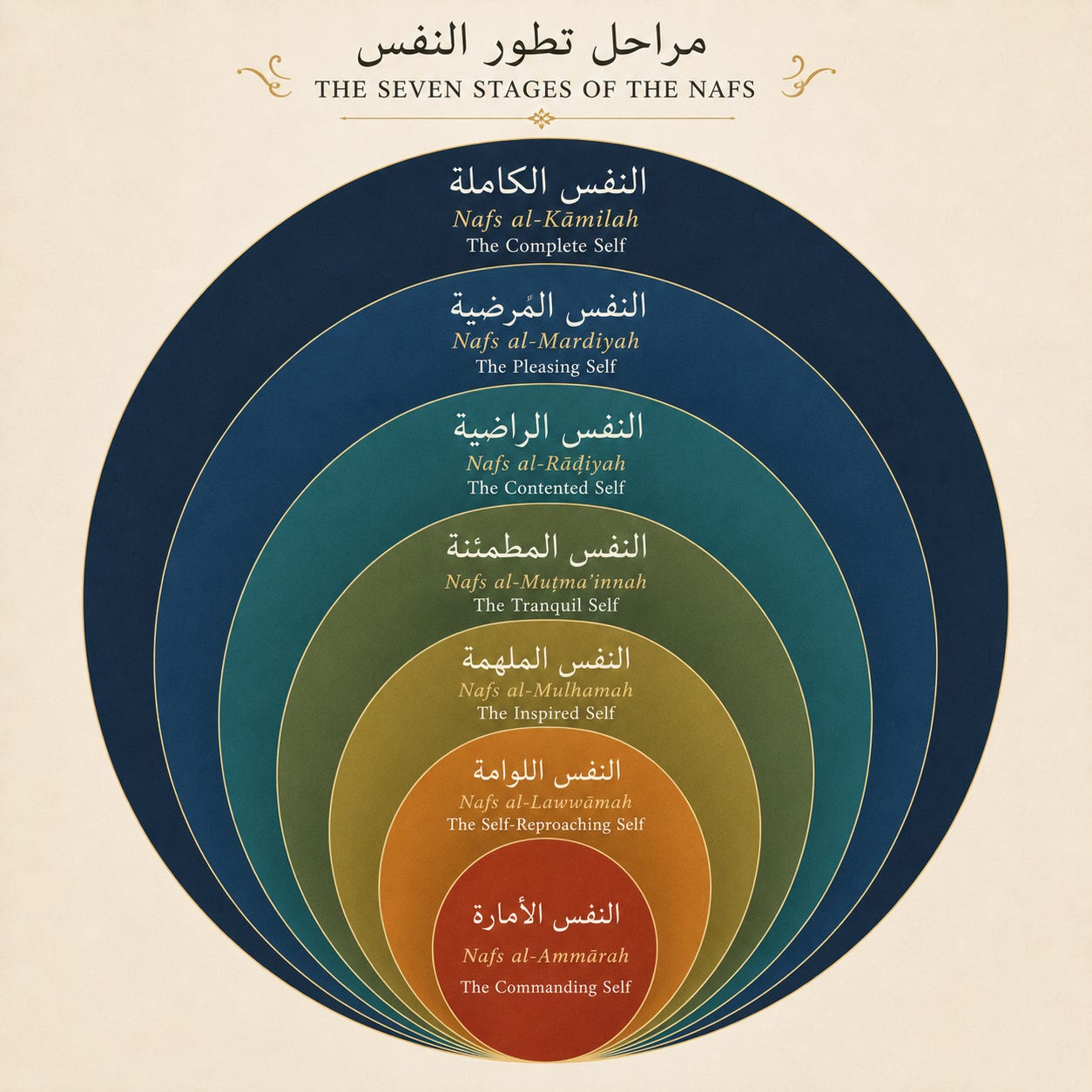
Many Sufi scholars describe the development of the nafs (self) as a journey of purification, remembrance, and return to God. Although the stages vary among different orders and authors, the sevenfold model of the nafs has become one of the most widely recognized frameworks in Sufism, offering a practical map of psychological and spiritual development.
Although often presented as successive stages, the development of the nafs is better understood as an unfolding process than a simple linear ascent. Earlier tendencies do not disappear as the person matures, but are gradually disciplined and refined. From a contemporary psychological perspective, we might also understand this as a process of integration. Like nested circles, each stage enfolds what came before, drawing the whole person toward greater harmony with God.
The Commanding Self (Nafs al Ammārah)
The journey begins with the self governed primarily by instinct, desire, and immediate gratification. Spiritual work begins by recognizing these impulses and learning not to be ruled by them.
The Self-Reproaching Self (Nafs al Lawwāmah)
Conscience awakens. Individuals become more aware of their shortcomings and wrestle with guilt, shame, and inner conflict. Though often painful, this stage cultivates sincere self-examination and accountability.
The Inspired Self (Nafs al Mulhamah)
Through practices such as dhikr (remembrance) and tafakkur (contemplation), intuition and spiritual insight begin to emerge. Moments of inspiration complement ordinary reasoning, fostering greater receptivity to Divine guidance.
The Tranquil Self (Nafs al Muṭmaʾinnah)
As attachment to the ego loosens, the heart becomes more fully the centre of one’s life. This stage is marked by an abiding inner peace born of trust and surrender to God.
The Contented and Pleasing Self (Nafs al Rāḍiyah and Nafs al Marḍiyyah)
These closely related stages express a mature acceptance of the Divine decree. Personal desires become more deeply aligned with the Divine will, and one’s life is marked by gratitude, sincerity, wisdom, and service.
The Complete Self (Nafs al Kāmilah)
The final stage represents the culmination of the soul’s refinement. Rather than withdrawing from the world, the individual can participate in ordinary life with presence, mercy, wisdom, humility, and service.
Some Sufi authors describe this final stage as Nafs al Kāmilah (the Complete Self). Others prefer Nafs al Ṣāfiyyah (the Purified Self), reserving complete perfection for the Prophet Muḥammad ﷺ. Although the terminology varies, both descriptions point toward profound purification from domination by the ego and a deepening orientation toward God.
Related to this journey are the Sufi concepts of fanāʾ and baqāʾ. Fanāʾ describes the passing away of egoic self-assertion and attachment before God, rather than the literal annihilation of the person. Baqāʾ, often described as subsistence or abiding in God, points toward a return to life and creation with a transformed relationship to the self. The person remains fully human and engaged in the world, but lives increasingly from remembrance rather than forgetfulness.
The following psychological parallels are illustrative rather than exact equivalents:
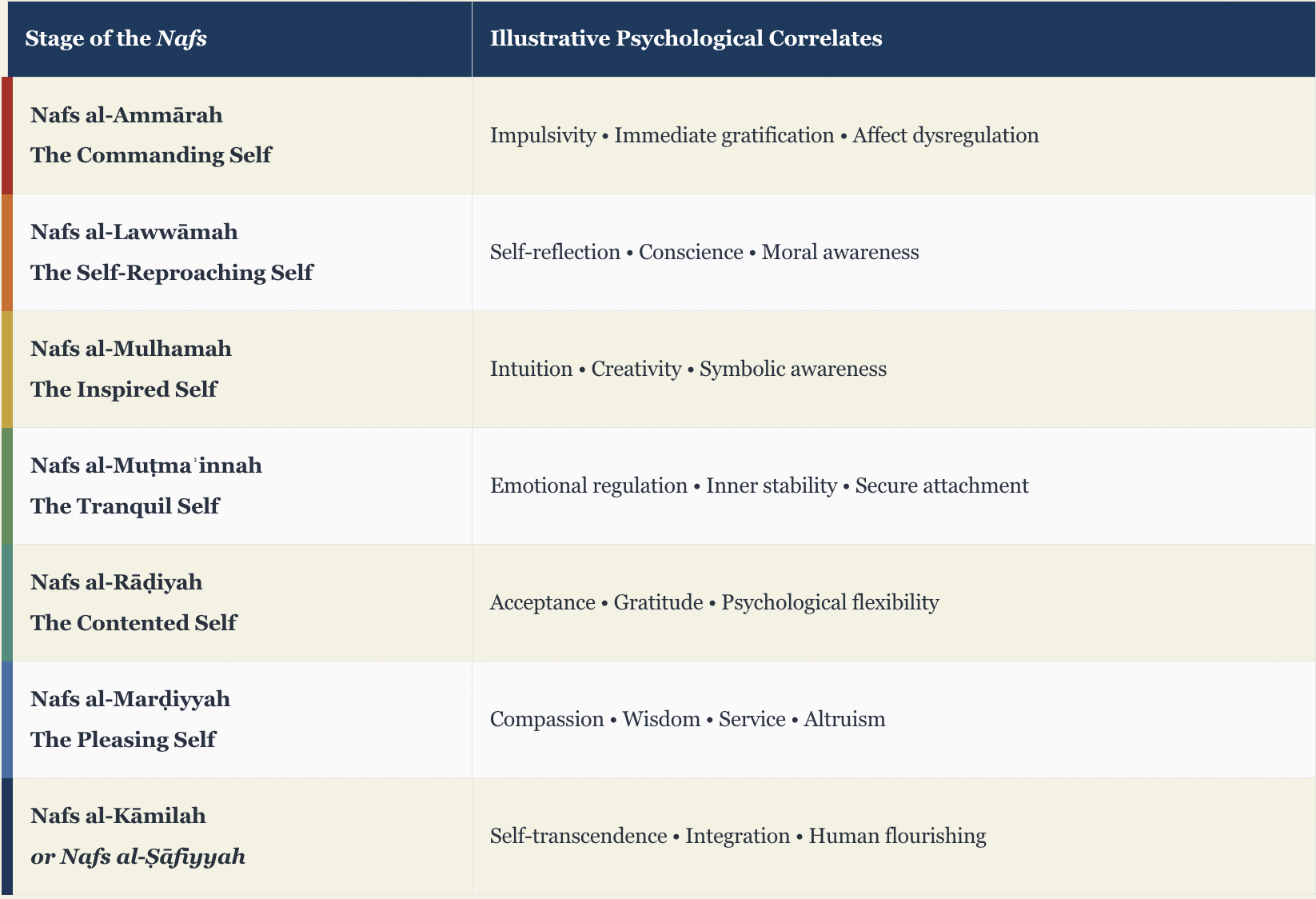
The journey of the nafs reminds us that psychological growth is more than the resolution of symptoms; it is the gradual reordering of the human person. While many contemporary psychological models rightly emphasize self-actualization as an important dimension of flourishing, the Sufi tradition ultimately points beyond it toward self-transcendence: becoming more fully human through the remembrance of God.
Case Study
The following case study was written collaboratively with the client and is shared with permission. Certain identifying details have been modified to protect privacy while preserving the integrity of the psychological journey.
Presentation
In August 2023, a twenty-nine-year-old woman, whom I will call Sarah, entered my office emotionally shattered and on the edge of despair. With remarkable calmness, she told me she was ready to end her life. Sarah had long identified as an atheist and committed rationalist, believing science to be the only reliable source of knowledge. Yet it was during this profound psychological crisis that her carefully constructed worldview began to unravel.
Sarah’s presentation was serious, and I treated it accordingly. Once we had established her immediate safety, it became clear that our work could not end with crisis management alone. She had chosen to come to therapy. She had allowed herself to be seen and had entrusted another person with the depth of her suffering.
Rather than trying to persuade her that life was worth living, I gently offered another possibility.
“Perhaps you have already walked through hell,” I said. “Maybe the question is no longer whether you want to die, but whether you are ready to begin living differently.”
The fact that she had walked through the door suggested that, beneath the despair, some movement toward life remained.
Understanding the Wound
As we gradually explored her history, the roots of her suffering began to emerge.
Sarah’s heart had been shattered by two profound relational betrayals involving the people she trusted most. Over nearly a decade, she came to believe she was fundamentally defective, unworthy of love, and responsible for the suffering around her. What began as heartbreak gradually crystallized into an identity organized around toxic shame, relentless self-judgment, and existential despair.
As self-hatred dominated her inner world, she withdrew from life. She isolated herself from friends, abandoned activities she once loved, lost three jobs within a matter of months, survived largely on fast food, and often slept for days at a time to escape consciousness.
Living in her parents’ home, she became caught in volatile conflicts with her mother, saying things that shocked even herself and further reinforced her conviction that she was beyond redemption. As therapy unfolded, it became apparent that Sarah had long occupied the role of scapegoat within her family system. Much of the shame and rage she carried seemed to reflect not only her own suffering, but also unresolved dynamics within the family. Her long-term romantic relationship recreated many of these patterns, reinforcing childhood wounds and keeping her trapped in familiar cycles of trauma.
Her loneliness became all-consuming. The world felt empty of meaning, and she experienced herself as profoundly separated from other people, from hope, and from life itself. The daily cycle of rage, sadness, shame, and despair became so relentless that she concluded the most compassionate act she could offer those she loved was to remove herself from their lives.
With only a few hundred dollars remaining in her bank account, Sarah packed her car and began driving, intending to continue until she ran out of money and fuel. She planned to find the nearest bridge and end her life.
Yet beneath the intensity of her suffering, something within her continued to move toward life.
Although convinced there was no future, she allowed herself to reach out. She accepted an offer of a complimentary therapy session. When her mother reported her missing, and the police eventually located her, she answered their calls, accepted their help, spoke with a hospital counsellor, and ultimately returned home.
Looking back, Sarah recognized that these decisions did not arise from hope. They arose from something quieter and deeper: a small but persistent movement toward life that survived even when her conscious mind insisted there was none.

Therapeutic Process
Our work drew upon dream analysis, poetry, mindfulness, somatic awareness, contemplative practice, and transpersonal psychotherapy while remaining grounded in established clinical practice. Drawing primarily from Buddhist and Sufi contemplative traditions, we explored shared psychological principles without requiring adherence to either religious framework. Rather than viewing suffering solely as pathology to eliminate, we explored whether it might also become a catalyst for transformation.
Several months later, Sarah travelled to Nepal to volunteer. Having had little prior interest in spirituality or religion, she accepted a friend’s invitation to attend a ten-day Vipassanā meditation retreat in the Theravāda Buddhist tradition. For the first time in her life, she experienced the profound stillness of a quiet mind. Rather than removing her suffering, the retreat revealed that another way of relating to it was possible.
Over the following three years, psychotherapy, meditation, and a willingness to explore new ways of understanding herself transformed Sarah’s relationship to her inner world. The shame remained real, but it no longer defined the entirety of her identity. She began to recognize that the story she had believed about herself was only one part of a much larger narrative.
Transformation
As Sarah’s perspective widened, meaningful changes emerged in her daily life. She stopped smoking and drinking, replaced coffee with green tea, began exercising regularly, secured stable full-time employment, moved into a home with supportive roommates, rekindled old friendships and hobbies, and repaired her relationship with her family, whom she now visits regularly. Meditation, reading, and contemplative practice became enduring parts of her life.
None of these changes erased her suffering. Long-standing habits of self-criticism continue to arise. The difference is that they are no longer experienced as absolute truth. Alongside them has emerged something that once seemed impossible: greater awareness, spaciousness, and, at times, genuine compassion toward herself.
Clinical Reflection
Sarah’s story illustrates one of the central arguments of this essay. Psychological healing does not require adopting a particular religious identity. Throughout our work, she continued to identify as an atheist. What proved transformative was not assent to a theological system, but a willingness to encounter her suffering through perspectives that extended beyond a purely pathological understanding.
Her journey remains unfinished. Like all of us, she continues to wrestle with deeply conditioned patterns of thought and emotion. Yet where there was once only shame, fear, judgment, and despair, there is now also curiosity, resilience, and an increasing capacity to remain present with her own experience.
Healing, in her case, did not consist in becoming someone else. It began when she discovered, slowly and imperfectly, that she was more than the story her suffering had taught her to believe.
Sufism in Dialogue with Transpersonal Psychology
The Sufi tradition has developed a remarkably sophisticated psychology of the soul. While Sufism represents one dimension of the broader Islamic intellectual tradition, it remains deeply rooted in the Qur’an and the Prophetic tradition, offering some of Islam’s richest ethical, psychological, and contemplative frameworks.
Sufi scholars not only catalogued mystical experiences and extraordinary states of consciousness, but also developed a nuanced language for distinguishing between spiritual states (aḥwāl), enduring stations (maqāmāt), inner promptings (khawāṭir), inspirations (ilhām), unveilings (mukāshafāt), spiritual influxes (wāridāt), dreams, and the many subtle movements of the heart and soul. These are not isolated concepts, but dimensions of an integrated understanding refined through centuries of scholarship, spiritual companionship, ethical discipline, and lived experience.
Contemporary transpersonal psychology has likewise reopened important questions concerning consciousness, spirituality, mystical experience, and self-transcendence within modern psychology. Although the two traditions arise from different historical, philosophical, and theological foundations, they converge in recognizing that human flourishing cannot be reduced to symptom relief alone.
Their differences, however, are equally important. Transpersonal psychology generally remains concerned with psychological integration and human flourishing, whereas Sufism ultimately orients the entire process toward knowledge of God. Mystical experiences, contemplative practices, and states of expanded consciousness are therefore understood not as achievements in themselves, but as occasions for greater humility, ethical refinement, and remembrance.
It is here that Islamic psychology enters into meaningful dialogue with contemporary psychology. Rather than replacing contemporary approaches, it broadens the conversation by inviting us to consider the human person not only as a biological and psychological being, but also as an ethical and spiritual one.
V. Returning to the Self
Conclusion
Healing has never belonged to psychology alone. Across cultures and civilizations, it has also been understood as a philosophical, ethical, and, for many traditions, spiritual concern. Contemporary transpersonal psychology has helped reopen this broader conversation within modern psychology. Islamic philosophy, through its philosophical and mystical traditions, has cultivated these questions for centuries.
Although the thinkers we have encountered differ in important ways, they share a common intuition: healing concerns not only what we think or feel, but who we become. It is not merely the reduction of symptoms, but the gradual integration of mind, heart, character, and soul.
Expanding psychology does not require rejecting science. It invites us to widen the frame by including intellectual traditions that have long reflected on consciousness, ethics, suffering, and human flourishing. Science helps us understand the mechanisms of the mind. Philosophy asks what is true. Contemplative traditions ask how truth is to be embodied in a human life.
This essay has focused primarily on philosophical foundations rather than the practical development of therapeutic models. There is much more to explore: how these understandings of the human person might shape clinical practice, how they might enter into dialogue with contemporary therapeutic approaches, and where genuine integration is possible without collapsing one tradition into another.
These are conversations I hope to continue through Mishkāt Journals. For now, all essays remain freely available. If you would like to follow along, you are welcome to subscribe for free. Paid subscriptions are entirely optional and help support the journal's research, writing, and continued growth.
Within the Sufi tradition, this lifelong journey begins and ends with dhikr, remembrance. Not because God has forgotten us, but because we so easily forget who we are in relation to God, to one another, and to ourselves.

A Contemplative Exercise
Throughout this essay, I have suggested that the Islamic understanding of the human person offers a different way of thinking about the self. Although the terms are not exact equivalents, readers familiar with psychology may find it helpful to think of the nafs as encompassing many of the functions often associated with the ego. In this sense, the ego is not an enemy to be hated or destroyed. It is part of what enables us to survive, form an identity, establish boundaries, make decisions, and navigate the world.
The aim of the spiritual path is therefore not the annihilation of the ego, but its refinement. Islamic psychology understands the nafs as capable of transformation. Rather than remaining governed by fear, pride, anger, or the endless pursuit of control, it can become more receptive to truth, beauty, mercy, and ultimately to the guidance of the rūḥ. The journey is not from self to no-self, but from an ego that imagines itself sovereign to a self increasingly oriented toward God.
Set aside twenty to thirty minutes in a quiet place.
Take a few slow breaths and ask yourself:
Who, or what, has been guiding my life lately?
Has it been fear? The need to control? The desire to be admired? Shame? Anger? Compassion? Love? Trust?
Now write two letters.
In the first, allow your nafs to speak without interruption. Let it tell you what it is trying to protect. What does it fear? What does it long for? What burdens has it been carrying? What story has it been telling itself?
When you have finished, set the letter aside.
Pause for a moment.
Now write a second letter, not from the voice of the ego, but from the deepest place of wisdom, mercy, and truthfulness you can presently access. Write from a place of remembrance, as though your life were already more fully oriented toward God. What would you say to your nafs? What would you reassure? What illusions would you gently uncover? What would you invite yourself to trust?
Leave both letters untouched for a day or two before returning to them.
Then ask yourself:
What was my nafs trying to protect?
What fears seemed to govern its decisions?
Where did I notice spaciousness instead of constriction?
What would it look like to take one small step this week from egoic reactivity toward remembrance?
This practice is not about rejecting the ego or denying our humanity. It is an invitation to witness the gradual refinement of the nafs: a movement from fear toward trust, from fragmentation toward wholeness, and from self-centredness toward a life increasingly oriented toward God.
Suggested Readings
Islamic Philosophy
Peter Adamson, Philosophy in the Islamic World (Oxford University Press, 2016).
Oliver Leaman, An Introduction to Classical Islamic Philosophy (Cambridge University Press, 2001).
Seyyed Hossein Nasr, Islamic Philosophy from Its Origin to the Present (SUNY Press, 2006).
Seyyed Hossein Nasr, Three Muslim Sages (Harvard University Press, 1964).
Sufism and Islamic Psychology
William C. Chittick, The Sufi Path of Knowledge: Ibn al-ʿArabī’s Metaphysics of Imagination (SUNY Press, 1989).
William C. Chittick, The Self-Disclosure of God (SUNY Press, 1998).
Robert Frager, Heart, Self, and Soul: The Sufi Psychology of Growth, Balance, and Harmony (Quest Books, 1999).
Toshihiko Izutsu, Sufism and Taoism (University of California Press, 1984).
Psychology, Meaning, and Transpersonal Thought
Viktor E. Frankl, Man’s Search for Meaning (Beacon Press, 2006).
Abraham H. Maslow, Toward a Psychology of Being (Martino Fine Books, 2013 [1968]).
Carl R. Rogers, On Becoming a Person (Mariner Books, 1995 [1961]).
Frances Vaughan, The Inward Arc: Healing and Wholeness in Psychotherapy and Spirituality (iUniverse, 1995).
Carl G. Jung, Modern Man in Search of a Soul (Routledge, various editions).
Stanislav Grof, The Adventure of Self-Discovery (SUNY Press, 1988).
Editorial Disclosure
AI assisted with clarity, structure, grammar, and formatting. The research, ideas, interpretations, lived experience, and final editorial decisions are my own.